
Dust and Bones
On mortality, glory, and the bones of Saint Francis

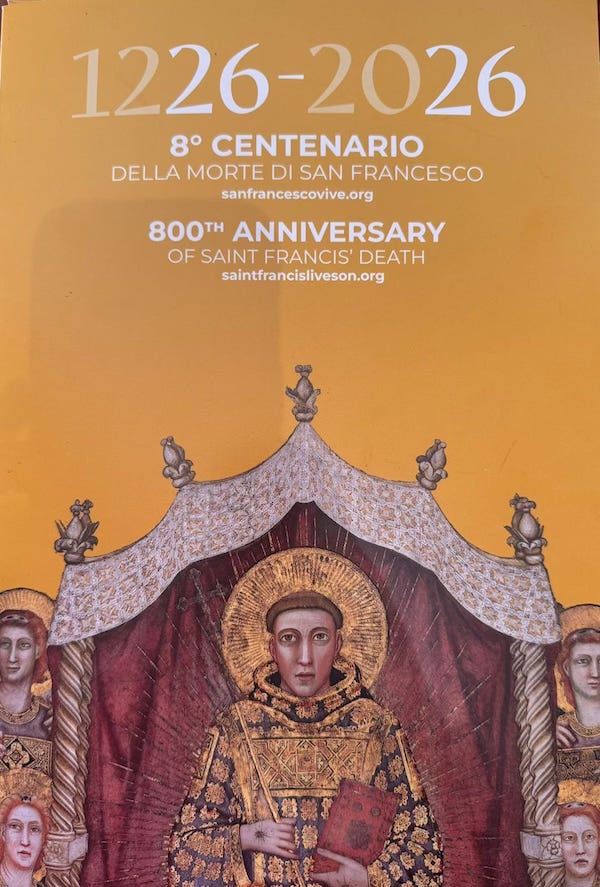
Last week in Assisi, I entered the Lower Basilica of the Basilica of Saint Francis of Assisi to venerate the bones of Francis of Assisi, now visible to the faithful for the first time since his death eight hundred years ago. The Church has marked this anniversary with a special Franciscan Jubilee, and pilgrims have begun making their way to Assisi in steady numbers, knowing that the relics will only be available for public veneration until March 22.
What struck me first was not emotion but order. The friars and volunteers had established a single, continuous line that moved gradually toward the glass case containing his remains. Small groups were guided forward, allowed a brief moment to pray, and then gently directed along so that others could approach. There was no dramatic lingering, no atmosphere of frenzy or spectacle. The structure of the process felt almost monastic in its simplicity: you came, you stood before what remained of him, you prayed, and you moved on.
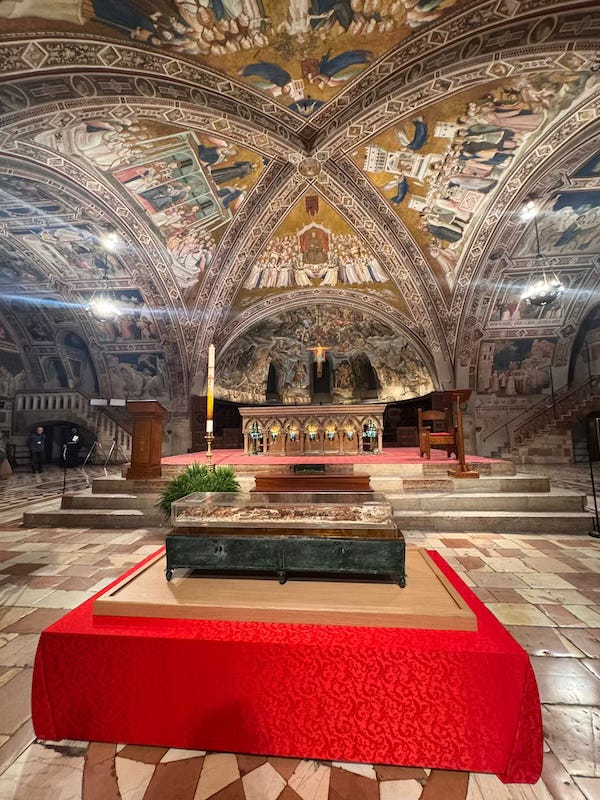
And yet the efficiency did nothing to diminish the weight of the encounter.
When my turn came and I stepped forward, I was surprised by the scale of what I saw. The bones are not imposing. They do not overwhelm you. They are fragile in a way that feels almost startling when you consider the magnitude of the life they once carried. This was the body of a man whose witness reshaped the Church’s very life and imagination, whose embrace of poverty challenged an entire social order, whose love for Christ ignited a movement that continues eight centuries later.
Now, what remains of Saint Francis is slight and breakable.
As I stood there, the words from Ash Wednesday rose in my mind with a clarity that felt less devotional and more undeniable: Remember that you are dust, and unto dust you shall return.
I have heard those words every year since childhood. I have received ashes on my forehead in cathedrals, in parish churches, in convent chapels. I have spoken about their meaning. But looking at the visible remains of a saint whose life altered history, the phrase no longer felt liturgical or symbolic. It felt biological. It felt exact.
Here was a man venerated across continents and centuries. The Church has attached a plenary indulgence to this jubilee year in his honor, recognizing the depth of his witness and inviting the faithful to participate in grace through pilgrimage and prayer. We profess that he lives fully in heaven, interceding before the throne of God. His name is invoked in the Liturgy. His spirituality continues to inspire and shape countless vocations.
And still, his body has followed the same trajectory as every human body before and after him.
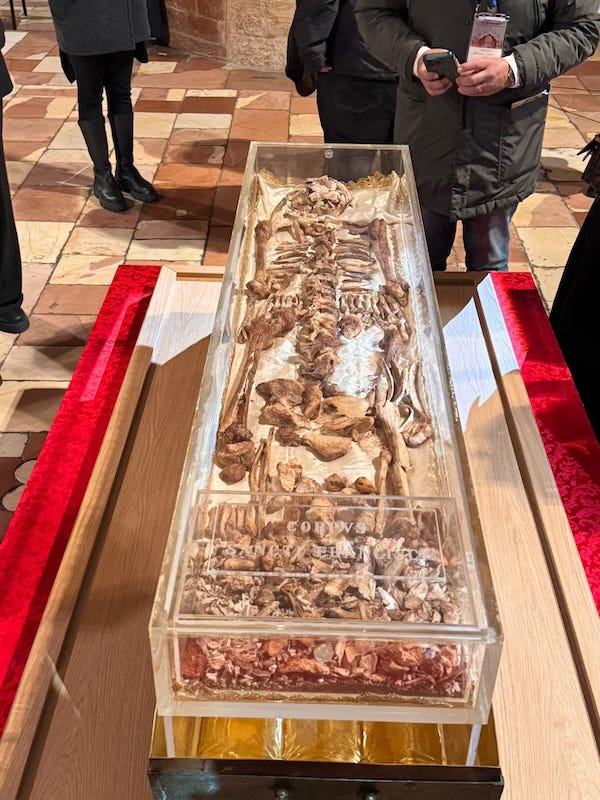
Christianity refuses to collapse that tension. We believe in resurrection and we acknowledge decay. We proclaim eternal life while fully acknowledging death. We do not pretend the body escapes dissolution, and we do not believe dissolution has the final word.
Genesis tells us that man was formed from the dust of the earth and that God breathed into him the breath of life. Dust is not accidental material; it is deliberate. It is chosen. The problem is not that we are dust. The problem is that we forget we are creatures shaped from it.
Francis did not forget.
He was born into comfort and expectation, into a life that could have remained secure and admired. Instead, he relinquished inheritance and status in order to conform himself more closely to Christ. His poverty was not theatrical; it was concrete and radical. He divested himself of control and embraced dependence in a way that makes modern sensibilities uneasy. His sanctity did not consist in transcending the limits of the body but in accepting them.
Standing before his bones, I began to understand that more clearly. His greatness did not lie in escaping dust. It lay in allowing love to animate his brief span within it.
We live in a culture that expends enormous energy trying to preserve itself. We preserve youth, preserve relevance, preserve image. We speak about building legacy and leaving impact, as though permanence can be engineered through effort and strategy. Yet bones level every hierarchy. The saint and the unknown laborer share the same biological destiny.
What differs is not the inevitability of decay but the quality of love.
What has endured of Francis is not the structure of his skeleton but the charity that shaped his life: the love that compelled him to rebuild a ruined chapel after hearing Christ’s call, the love that led him to embrace the leper he once feared, the love that saw creation not as property but as kin, the love that kept him obedient to the Church even when misunderstood. That love did not disintegrate with his flesh.
We believe that at the end of time, when Christ returns, the body and soul will be reunited. The resurrection of the body is not metaphorical comfort but doctrinal promise. Francis’ bones are not relics of defeat; they are fragments awaiting restoration. Christianity does not treat the body as disposable. It insists that it matters enough to be raised.
But until that day, we remain what we were made from.
Dust, yes — but dust into which God chose to breathe His own life.
When I stepped away from the glass case and merged back into the steady movement of pilgrims exiting the Basilica, I felt something in me recalibrate. The urgency to prove, to establish, to secure recognition softened. If even a saint whose life transformed the Church has returned physically to the earth, then the measure of a life cannot ultimately be its visibility.
It must be its love.
The world measures endurance in scale and recognition. The Gospel measures endurance in charity. Love rooted in God does not decay; it is taken up into eternity. Relics confront us with this reality in a way that abstraction cannot. They remind us that holiness unfolded in a body subject to hunger, fatigue, vulnerability, and eventually death.
The words spoken on Ash Wednesday are not meant to diminish human dignity. They are meant to situate it. To remember that we are dust is to remember that we are creatures, not self-originating gods. Our existence is received. Our dignity is breathed into us.
Francis understood that belonging to the Father was the source of his identity. Once that is secure, poverty ceases to terrify. Obscurity ceases to threaten. Death ceases to annihilate.
Every project we build will eventually pass into other hands. Every reputation will fade. Every body will weaken. The bones will rest and eventually become dust.
What remains is the degree to which we allowed love to shape us between the first breath and the last.
Standing there in Assisi, having looked directly at what is left of a man who once trembled with love for God, I did not feel despair. I felt something steadier than that.
We are dust.
And we are destined for glory.
Between those two truths lies the only question that ultimately matters: what will we choose to love?
Assisi is one of those rare places where the history of the Church feels almost tangible.
Because many readers have asked about visiting, I’m currently finishing a short pilgrim’s guide to Assisi—a practical and spiritual companion for those hoping to walk in the footsteps of Saint Francis.
It will be available for purchase soon. Subscribers will be the first to receive it when it’s released.
And as always, please feel free to comment and share. I love reading your thoughts and reflections on these pieces.
Wow!! Thanks so much for sharing this. And I agree, the photo of him with your reflection on our coming from and returning to dust…powerful!
Very cool read Marilis! The connection you made to the Ash Wednesday words about dust was powerful for this sort of reading. It’s easy to hear that phrase every year and let it pass by without really thinking about it, but seeing the remains of someone whose life shaped the Church makes it feel very easy to read. I liked the way you framed it that his greatness wasn’t escaping dust but letting love fill the time he had within it. That line about bones leveling every hierarchy also stuck with me. It’s a simple idea but it says a lot about how we measure a life.